

How to Perform CPR on Adults: A UK Guide and Certification
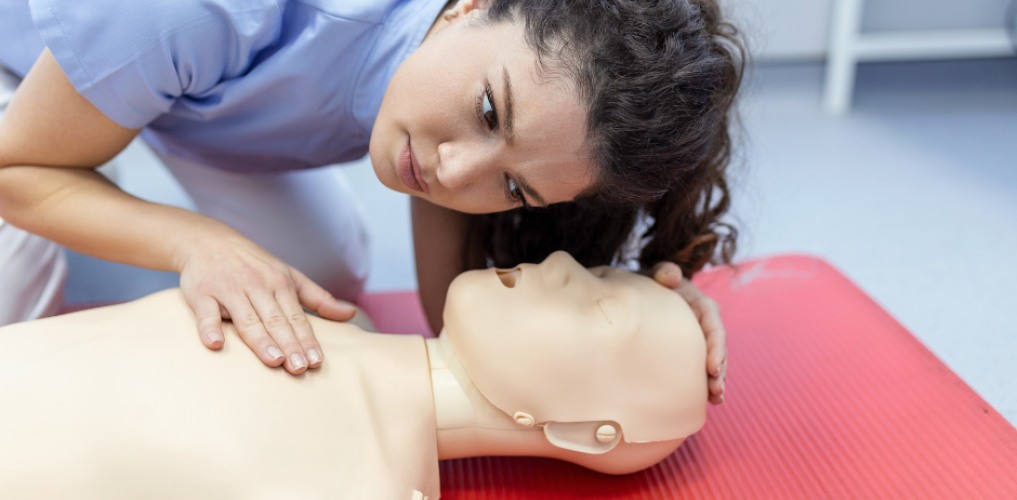
If someone collapses and is not breathing normally, they are in cardiac arrest, and CPR is what keeps them alive until the ambulance arrives. This guide covers how to respond, where to go for the authoritative UK guidance, and how proper certification turns that knowledge into the confidence to act.
This guide follows the current Resuscitation Council UK (2025) and NHS guidelines. It is intended as public information and does not replace practical, certified training on a course.
Book your BLS & AED training today
Online First Aid Refresher Training
Why the first two minutes decide the outcome
A cardiac arrest happens when the heart suddenly stops pumping. Without oxygen reaching the brain, damage begins within minutes and death follows quickly.
Bystander CPR and early use of a defibrillator increase the chances of survival by two to four times (Resuscitation Council UK).
Waiting for the ambulance is not a plan. The average category 1 ambulance response time in England was around 8 minutes 32 seconds in the most recent NHS reporting (NHS England). In cardiac arrest, that is a long time.
The person who starts CPR within the first minute is almost always the person standing next to the patient. You do not need to be a medic to make that difference.
You need to know what to do, and to start doing it straight away.
Cardiac arrest and heart attack are not the same
The two terms are often used interchangeably, but they describe different emergencies (Resuscitation Council UK).
A heart attack happens when an artery supplying the heart becomes blocked. The person is usually still conscious and may have chest, jaw, or arm pain. A heart attack can lead to a cardiac arrest, but not always.
A cardiac arrest happens when the heart stops pumping. The person collapses, is unresponsive, and either stops breathing or breathes abnormally, sometimes with slow, gasping, noisy breaths. Cardiac arrest is what adult CPR is for.
What to do in the first minutes of a cardiac arrest
If you see someone collapse and they are not breathing normally, the most important thing is not to panic. Take a breath. You are the help that has arrived, and you have more time than it feels. Call 999 straight away. Put the phone on loudspeaker so both your hands stay free.
The call handler is trained to guide bystanders through cardiac arrests every day, and they will stay on the line with you until the ambulance arrives.
You are not on your own, and you do not need to remember every step.
The Resuscitation Council UK sums the response up as three actions: check, call, CPR (Resuscitation Council UK). The call handler will walk you through each one.
If a defibrillator is nearby, they will tell you where.
For the full step by step guidance, the two authoritative UK sources are the Resuscitation Council UK's public CPR page and the NHS first aid CPR guidance.
Both are written for the public, both are free, and both are kept up to date with the current UK guidelines.
Staying calm is half the skill
Most people freeze in the first few seconds of an emergency. That is a normal response, and it passes quickly once you start doing something. The single most useful thing you can do is act, even imperfectly.
- Breathe. One slow breath before you approach. It sounds too simple, but it steadies your hands and your voice for the 999 call.
- Speak out loud. Say what you are doing as you do it. It slows your thinking, and it tells anyone nearby how to help.
- Delegate. If other people are there, give them jobs by name or by pointing. "You, call 999. You, find a defibrillator." Vague requests get ignored under stress.
- Trust the call handler. They have done this thousands of times. You have not. Listen to their instructions and let them lead.
- Keep going. Something is always better than nothing, and the ambulance is on its way. Your job is to bridge the gap.
You will not do it perfectly. Nobody does. What matters is that you do it.
Why practical training changes what happens next
Reading this is a valuable start. Knowing that 999 will talk you through it is a real comfort.
But in the moment when a colleague, family member, or stranger actually collapses in front of you, the difference between hesitation and action almost always comes down to whether you have practised.
Hands on training turns the theory into something your body remembers.
You have knelt beside a manikin, you have felt the depth of a real compression, you have used a training AED.
When adrenaline hits, that muscle memory carries you through the first minute while your thinking mind catches up.
That is what a proper course gives you: not more information, but the confidence to use it.
The Safe Haven Basic Life Support and AED course
The Safe Haven Basic Life Support and AED course is a half day certified course designed for exactly this.
It covers adult CPR, defibrillator use, the Chain of Survival, and the legal ground for stepping in under the SARAH Act 2015.
Delegates practise on manikins and training AEDs, with hands on assessment from experienced trainers.
- Duration: Half day
- Certificate validity: 1 year (annual refresher recommended)
- Accreditation: FAIB
- Group size: Up to 16 delegates per trainer
- Delivery: At your venue from £325 + VAT, or at one of our UK training venues
- Assessment: Practical CPR and AED assessment, plus a short knowledge check
Safe Haven Training courses meet the Health and Safety (First Aid) Regulations 1981 requirements. Certificates are issued within 48 hours of course completion.
Frequently asked questions
1. How do you perform CPR on an adult?
The Resuscitation Council UK sums the response up as three actions: check for a response, call 999, and start CPR. The 999 call handler will guide you through each step until the ambulance arrives. Full public guidance is available on the RCUK and NHS websites, but hands on certification is what builds the confidence to actually do it under pressure.
2. Should I give rescue breaths or hands only CPR?
If you have not been trained in rescue breaths, hands only CPR is a widely accepted option (NHS). The 999 call handler will guide you through what to do. A certified BLS and AED course teaches you both options, so you know when each is appropriate.
3. How long should I do CPR before stopping?
Continue until the ambulance crew arrives and takes over, a defibrillator instructs you to pause, or the person shows clear signs of life such as breathing normally or moving. The 999 call handler will stay on the line and guide you throughout.
4. What if I panic in an emergency?
Panic is normal, and it passes quickly once you start doing something. Call 999, put the phone on loudspeaker, and let the call handler guide you. You are not alone, and imperfect action is far better than no action.
5. Can I hurt someone by doing CPR when they do not need it?
Serious harm is very rare. The far greater risk is not starting CPR when someone is in cardiac arrest. The SARAH Act 2015 offers legal reassurance for people acting in good faith in an emergency.
6. Do I need to be certified to do CPR on someone?
No. Anyone can perform CPR in an emergency, and the 999 call handler will guide you through it. Certification builds the confidence and muscle memory to act quickly, which is why the NHS and Resuscitation Council UK encourage everyone to learn.
7. How do I get certified in CPR?
A half day Basic Life Support and AED course covers adult CPR, defibrillator use, and hands on assessment, and issues a one-year certificate. Longer workplace first aid qualifications, such as Emergency First Aid at Work or First Aid at Work, also include full CPR and AED training.
8. How often should CPR certification be renewed?
BLS and AED certificates are valid for one year. Workplace first aid certificates last three years, but annual refresher practice is recommended because CPR skills fade quickly without hands on use.
9. Is using an AED on someone safe if I'm not medically trained?
Yes. Public access defibrillators are designed for untrained members of the public. They analyse the heart rhythm and only deliver a shock if one is needed. The device gives spoken instructions to guide you.
Get properly certified in CPR and AED use. Book a half day Basic Life Support and AED course at your venue from £325 + VAT for 16 delegates, or at one of our UK training venues. Call 0800 260 6942 or email info@safehaventraining.co.uk to arrange dates that suit your team.
References
1. NHS (2026): First aid - CPR.
2. NHS England (2026): Ambulance quality indicators.
3. Resuscitation Council UK (2025): How to do CPR.
4. Resuscitation Council UK (2025): Adult basic life support guidelines.
5. Social Action, Responsibility and Heroism Act 2015 (c.3).