

How to Use a Defibrillator (AED) With Confidence
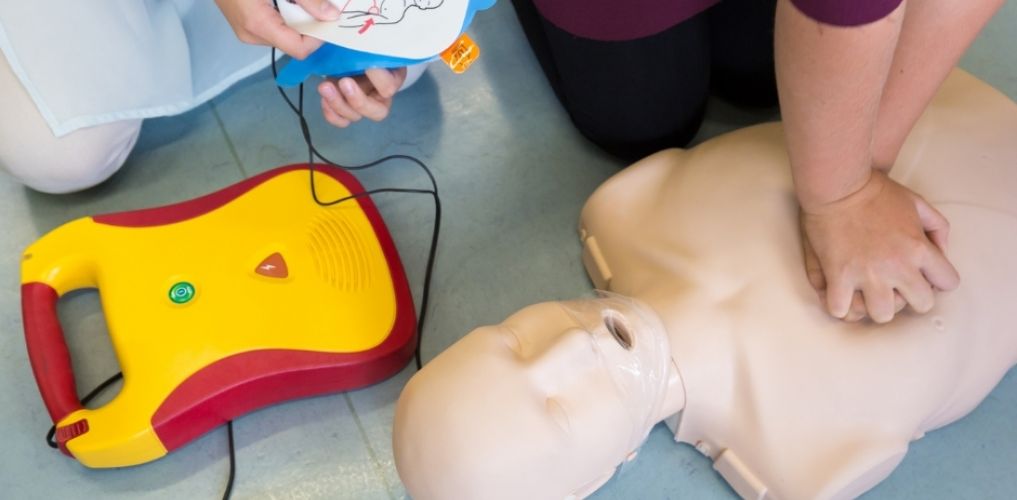
When someone collapses in cardiac arrest, every second counts. A defibrillator can be the difference between life and death.
Yet many people freeze, worried they will do something wrong. That hesitation is understandable, but it is rarely justified. A defibrillator is designed to be used by anyone, with or without training.
This guide explains what cardiac arrest is, what an AED does, and how to use one. We have kept adult and child usage separate, so the steps stay clear and practical.
Find a first aid training course near you
What is cardiac arrest?
Cardiac arrest is a life threatening emergency where the heart suddenly stops pumping blood around the body.
The person immediately becomes unconscious and stops breathing normally (Resuscitation Council UK). It is not the same as a heart attack, and the distinction matters.
A heart attack happens when a blood clot blocks an artery supplying the heart. During a heart attack, the person usually stays conscious and keeps breathing.
A defibrillator is not appropriate while the heart is still beating (Department for Education). Cardiac arrest, by contrast, means the heart has effectively stopped.
Without quick treatment, the person will die within minutes (Resuscitation Council UK). Sudden cardiac arrest occurs because the heart's normal electrical rhythm is replaced by a chaotic one.
This irregular rhythm is called ventricular fibrillation (Resuscitation Council UK).
It can happen to anyone, at any age, without warning. Possible causes include heart disease, blood loss, trauma, electrocution, and inherited conditions (Department for Education).
Why your response matters so much
The scale of the problem is sobering.
Around 100,000 people in England experience a sudden cardiac arrest each year, yet currently only about one in ten survive (Resuscitation Council UK).
Of those 100,000, ambulance services attempt resuscitation in roughly 30,000 cases. This gap is largely explained by delays in recognising cardiac arrest and starting CPR before help arrives (Resuscitation Council UK).
Speed is the single biggest factor you can influence. Early recognition, immediate CPR, and rapid defibrillation can more than double the chance of survival (Resuscitation Council UK).
Resuscitation Council UK sets out three simple actions that make the difference.
Recognise the cardiac arrest and dial 999, start chest compressions, and send someone to fetch a defibrillator. The clock is unforgiving.
For every minute's delay to defibrillation once resuscitation has started, the chance of survival falls by around 10% (Resuscitation Council UK).
Encouragingly, acting fast works. Using a defibrillator within three to five minutes of collapse can increase survival rates by up to 70% (Resuscitation Council UK).
What is a defibrillator (AED)?
An Automated External Defibrillator, or AED, is a portable device that delivers a controlled shock to the heart. It is used only when someone is in sudden cardiac arrest.
Automated External Defibrillator (AED)*
The device automatically detects the abnormal heart rhythm and tells you when a shock is needed. It will only deliver one if the rhythm may respond (Resuscitation Council UK).
Once switched on, the AED guides you with audio and visual prompts.
Resuscitation Council UK describes it well: following the device is like having an expert by your side.
You can now find public access defibrillators in many busy places. Airports, railway stations, shopping centres, and gyms commonly hold them (Resuscitation Council UK).
When you call 999, the call handler can direct you to the nearest registered device.
The national network, The Circuit, helps them locate it quickly (Resuscitation Council UK).
*the image is for reference purposes only
Are defibrillators safe to use?
This is the question that stops many people, so it is worth answering plainly.
In the UK, there are no legal restrictions on using a defibrillator.
By using one on someone who is unconscious and not breathing normally, you cannot make their condition worse.
The device only recommends a shock when the rhythm may respond to one. It also presents minimal risk to you as the rescuer.
The AED clearly warns everyone to stand clear before any shock is delivered.
It is usually safe to use an AED on a wet or metal surface too. If the chest is wet, simply dry it first so the pads adhere properly (Resuscitation Council UK).
How to use a defibrillator on an adult
Use these steps for anyone aged 18 and over. The AED will talk you through each one, so you are never working without guidance.
First, confirm the person is unconscious, unresponsive, and not breathing normally. This indicates a likely cardiac arrest.
2. Start CPR. Give 30 chest compressions at a rate of 100 to 120 per minute (Department for Education).
3. Add rescue breaths if you are trained and willing, giving two after every 30 compressions. If not, continue compression only CPR (Department for Education).
4. Send someone for the nearest AED. If you are alone, the ambulance service will bring one, so stay and keep doing CPR (Department for Education).
5. Switch the AED on and follow its spoken prompts from the moment it opens.
6. Attach the pads to the person's bare chest, positioned as shown on the pad packaging. Dry the chest first if it is wet.
7. Stand clear while the device analyses the rhythm. Make sure nobody is touching the person.
8. Deliver the shock if advised. Check again that everyone is clear, then press the button when prompted.
9. Resume CPR straight away and continue following the device until help arrives or the person shows signs of life.
The following illustrations show the steap by step use of an Automated External Defibrillator (AED).
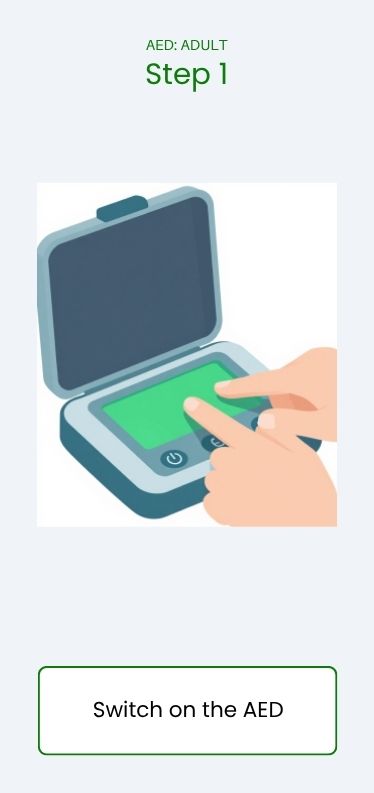
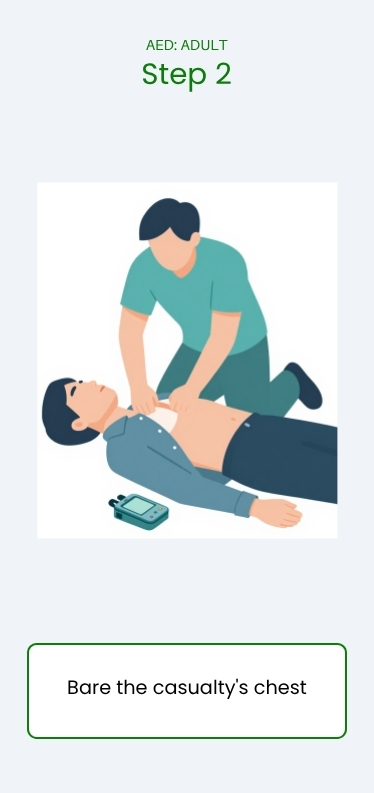
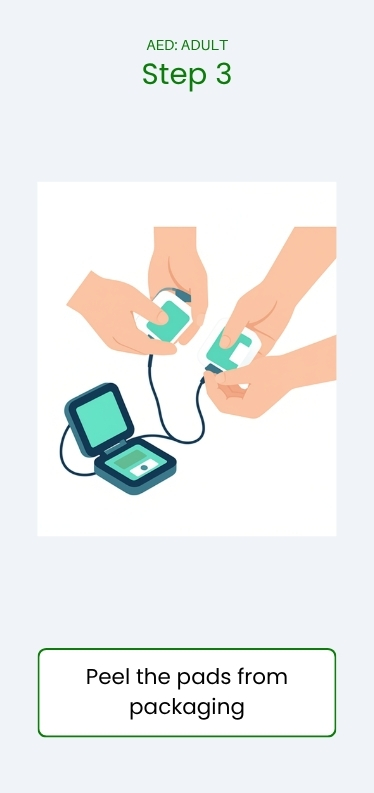
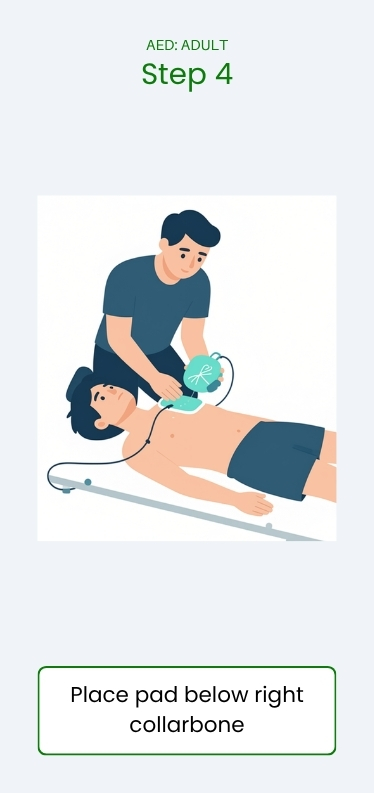
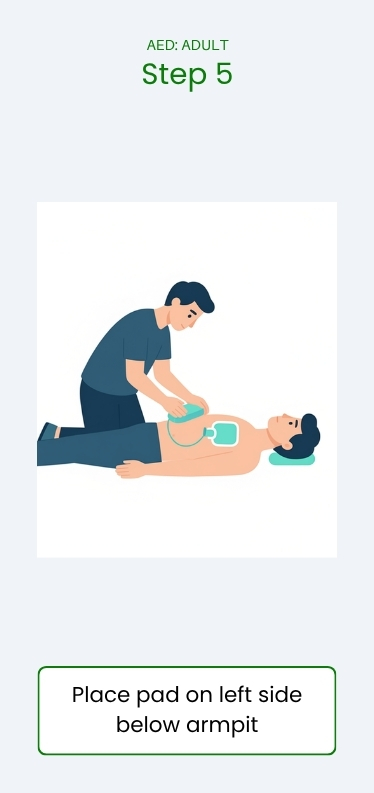
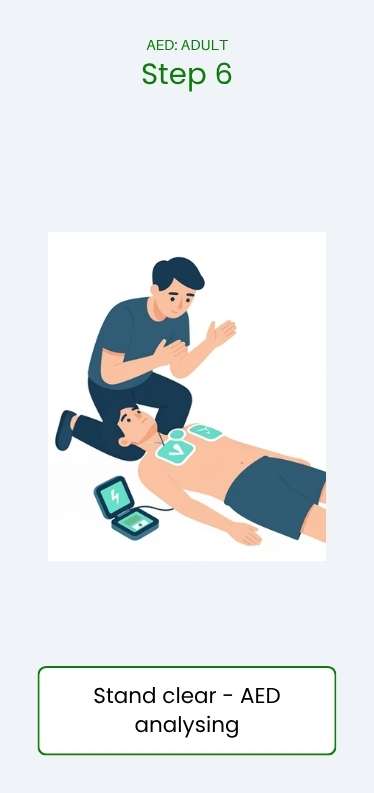
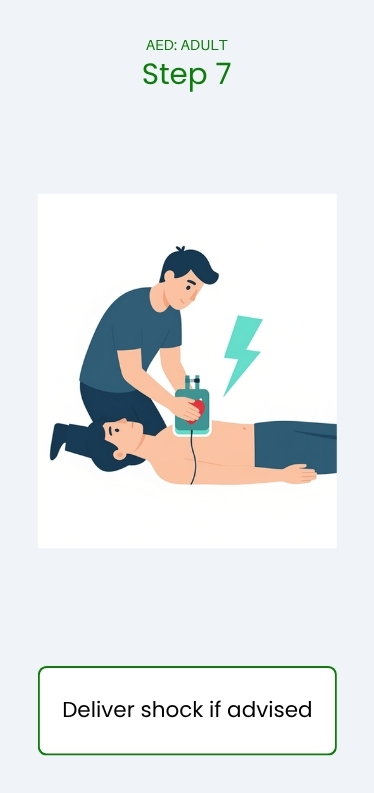
*images are for reference purposes only
The AED reassesses the rhythm at regular intervals. Some people will have a non-shockable rhythm, in which case continuing CPR is essential (Department for Education).
A note on pad placement: it does not matter if the pads are accidentally swapped left and right. They will still work (Department for Education).
Combining compressions with confident AED use is the heart of any good response.
Our AED and CPR course covers exactly this sequence and sits naturally alongside workplace qualifications such as Emergency First Aid at Work.
How the Department for Education guidance covers child AED usage
The priority for any child in cardiac arrest is high quality CPR and getting expert help. Shockable rhythms are far less common in children, but they can still occur (Resuscitation Council UK).
The Department for Education confirms that defibrillators can be used across all age groups. They are suitable for people of all ages, except small children under 12 months (Department for Education).
The CPR sequence differs slightly for children aged 1 to 17. You begin with five initial rescue breaths before moving to compressions (Department for Education).
After those breaths, give 30 chest compressions at 100 to 120 per minute. Then use the defibrillator if one is available (Department for Education).
Pads and modes for children
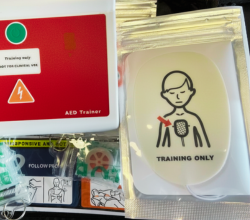
Children AED Pads
Some defibrillators let you indicate that it is being used on a child. This may be through a switch on the device, or by attaching paediatric pads where available (Resuscitation Council UK).
For a child aged 1 to 8, the guidance recommends paediatric pads or paediatric mode where these are supplied. This delivers an appropriate shock energy (Department for Education).
Defibrillation must never be delayed for the sake of finding paediatric pads. Adult pads and energy can be safely used on a child if that is the only resource available (Resuscitation Council UK).
If you do use adult pads on a child, take care that the two pads do not touch each other when the shock is delivered (Resuscitation Council UK).
Pad placement on small children
On infants and small children, the standard front placement may not leave enough space between pads.
In that case, place one pad on the centre of the chest and one on the back (Department for Education).
The aim is to position the heart directly between the two pads.
The back and front method achieves this when the pads cannot be separated on the front alone (Department for Education).
Infants under 12 months
Experience with AEDs on infants under one year is limited.
The device may still be used if no other option is available, as some intervention is better than none (Resuscitation Council UK).
If you are ever unsure, the 999 call handler will guide you through every step.
Anyone working with young children may also find our OFSTED aligned Paediatric First Aid course valuable, as it builds the same confidence around infants and children specifically.
Signs and posters that help you act
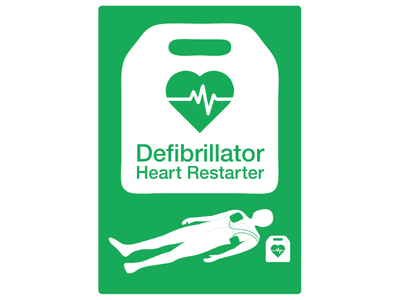
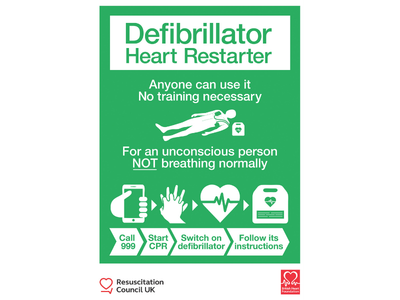
You do not have to memorise any of this in advance. Resuscitation Council UK provides a standard AED location sign and a step by step defibrillator poster, both designed to guide you in the moment. You will often spot the location sign in public places, marking where a defibrillator is kept. If your workplace or community holds a defibrillator, displaying them is a simple, no cost way to help anyone act with confidence. It can be downloaded free from the Resuscitation Council UK website.
Mistakes can happen, and that is alright
It is natural to worry about getting it wrong. In a real emergency, with adrenaline running high, mistakes can be made.
You might place a pad slightly off, or take a moment to read the prompts. None of this stops the device working.
The AED is built to forgive these moments. It will not shock a heart that does not need it, and it repeats its instructions calmly until you act.
The only genuine mistake is doing nothing at all. A person in cardiac arrest has the best chance when someone steps in, even imperfectly.
This is exactly why familiarisation helps. Resuscitation Council UK notes that while training is not required, it helps people feel more able and confident to act (Resuscitation Council UK).
Build your confidence with proper training
Defibrillators save lives precisely because they are simple. Still, there is real value in practising the full sequence before you ever need it.
Our AED and CPR course gives you supervised, hands on experience with both the device and chest compressions.
You leave knowing what each prompt means and how it feels to act under pressure.
We deliver training onsite at your workplace or at accessible venues across the UK.
Courses are designed around your team and your sector.
Ready to make sure your people can act when seconds matter?
Get a quote or check availability for AED and CPR training today.
References
1. Department for Education: Automated External Defibrillators (AEDs) - guidance for schools
2. Resuscitation Council UK Guidance: Defibrillators
3. Resuscitation Council UK Public access defibrillators: A guide for communities
4. Resuscitation Council UK: Updated AED guidance empowers communities to save lives